

Military Museum
Escape from the Ustashas: Families who fled to Serbia in 1941
On the occasion of the 80th anniversary of the formation of Jasenovac, the Museum of Genocide Victims in Belgrade has published several collections of documents, some of which are before the eyes of the general public for the first time and additionally shed light on facts related to one of the largest and most monstrous concentration camps in Europe. Among the new editions is the collection “Jasenovac Camp – Hearings of Serbian Refugees” by Veljko Đurić Mišina, director of the Museum of Genocide Victims, in which the testimonies of detainees given in 1942 before the Commissariat for Refugees and Migrants in Belgrade were published for the first time. The collection is impossible to obtain in free sale, and the Museum states that the book can be ordered by e-mail at: [email protected], after which it will forward instructions on the payment of money to cover costs or voluntary donation.
In 1942, the Commissariat for Refugees and Immigrants of the Government of Serbia conducted talks with most of the detainees in Jasenovac who managed to survive this concentration camp and reach Serbia. Many spent several months in this camp, and some only ten days, such as Slavko Kokoruša (38) from Visoko and Jovan Kovačević (34) from Sarajevo.
Death Factory
Slavko and Jovan described in detail what they experienced and saw in such a short time in the largest death factory in the Balkans.
Slavko Kokorush was an innkeeper and before he ended up in Jasenovac, he was tortured by local Ustasha Muslims who arrested and liquidated Serbs in this part of Bosnia on several occasions.
Finally, he was transferred to Jasenovac on May 10, 1942.
“When we arrived there, the Ustashas took away all our money, laundry, smoking accessories and everything we had with us. On the first evening, the Ustashas broke into the barracks, where we were accommodated, and took three Serbs and two Muslims out of the barracks, who were terribly beaten in front of the barracks, ostensibly because they were preparing to flee. However, there could be no talk of escape. The second day after our arrival in Jasenovac, which could have been on May 13, 1942, we saw smoke billowing from the brickyard, and at the same time a great stench was coming from there. We could smell human corpses burning. At that time, a Jew told us in confidence – a detainee who performs the duty of a gravedigger in the camp and who participates in the burning of corpses, that 40 children’s corpses were burned that day, including Serbian children, “said Kokorush, who died on May 18, 1942. a group of 500 prisoners from this prison was transferred to Zemun, where he remained until May 27, when he was transferred to Serbia, ie Belgrade.
Forced labor
The fate of Jovan Kovacevic, an official of the city government in Sarajevo, is similar. He was arrested in this city with a group of other prominent Serbs, and then around May 10, 1942, he was taken to Jasenovac, where he spent about a week.
“In that short time, I saw how difficult and horrible the detainees were exposed to in the camp itself. I saw how brutally people are forced to work, and what kind of work they do. I also had to work when assembling bricks and stones from the destroyed Serbian church in Jasenovac. Upon arrival at the camp, the Ustashas immediately separated from our party, which came from Sarajevo, to the side of the craftsmen and sent them to work in the camp workshops, and the rest of us were immediately told to go to Zemun as a supplement for the labor service. And so about 150 of us from the Sarajevo party with the party of Serb peasants from Jasenovac and Bosanska Dubica, a total of about 650 people, set off and arrived in Zemun on May 17. We stayed in Zemun for seven days, and during this time, a party of 700 people arrived from Nova Gradiška, scheduled to work in Germany. In Zemun, old people were separated from younger and able-bodied people. Thus, about 150 elderly people were separated from our transport, who were told that they would be transferred to Serbia, namely those who are Serbs, and Muslims and Croats that they would be released home. However, quite unexpectedly, 26 Serbs were singled out, who came from Jasenovac and were sent by German soldiers to Belgrade, where we were accepted by the envoy of the Commissariat for Refugees and placed temporarily in the Theological Boarding School, “said this witness.
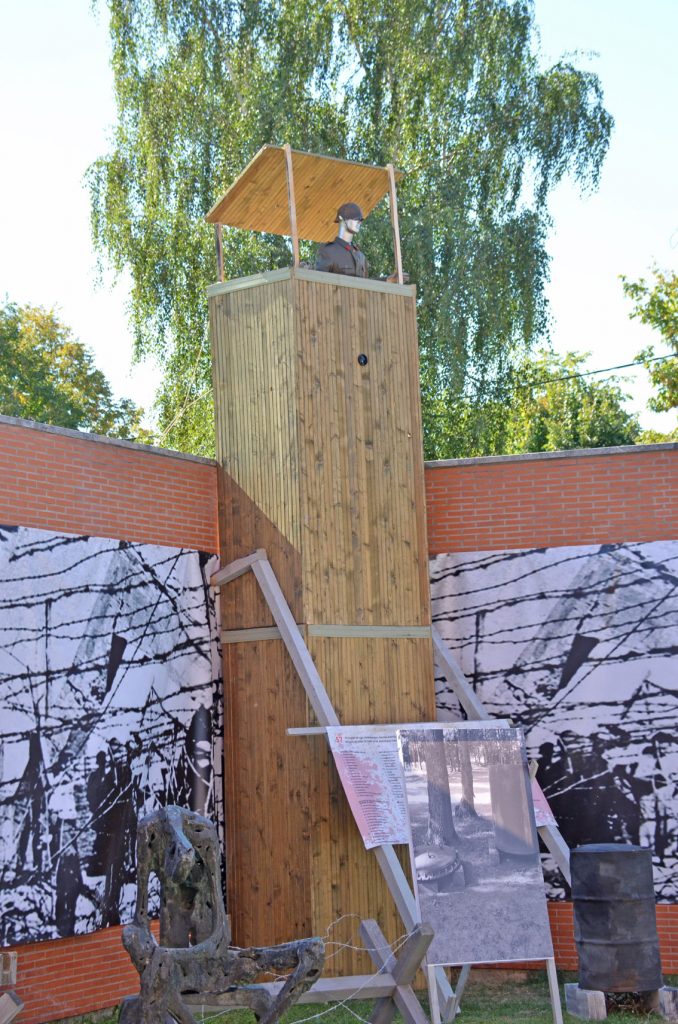 Camp Observatory Part of the exhibition “Jasenovac – the right to be remembered”
Police prison
Jovan Kovacevic said that only in the first half of April 1942, 250 people were arrested in Sarajevo, of which – two thirds of Serbs, and that 180 of them were immediately transferred to Jasenovac.
“I was arrested on April 16 and first taken to the police prison, and after eight days to the court prison in the judicial palace, where I was taken for questioning, which I also submitted in the name of help for poor and injured Serbs. Even if the manager of the court prison told us that no one would touch us in this prison, the police agents forcibly extorted confessions from many detainees under beatings. “It was far up in the police prison where people were formally beaten and died under beatings, as was the case with Muslim Shipic, who died under beatings in the hospital where he was transferred from the police prison in serious condition,” he said. witness.
Arrests of home guards
Kovacevic stated that there were many Croats among those arrested, but also officers and soldiers of the Croatian Home Guard.
“During my time, there were 26 Home Guard officers and a slightly smaller number of Home Guard soldiers in the police prison, who were charged with maintaining ties with Serbian Chetniks and insurgents, and Croatian aviation officers with not dropping bombs from planes during a fight with Chetniks. Chetnik positions than anywhere else, and even if they deliberately dropped bombs on the positions where the Ustashas and Home Guards were. Among the arrested Croatian Home Guard officers in the police prison, I saw: Colonel Filipović, Lieutenant Colonel Poj, Lieutenant Colonel Radaslić, Muslin, Lieutenant, Rezaković, Muslims, while I do not know the names of others. As I mentioned, there were 25 officers of the Croatian army. These officers of the Croatian army were escorted to Zagreb, while ordinary Croatian soldiers were put in a transport in which I also came to Jasenovac. “

Comments are closed.